
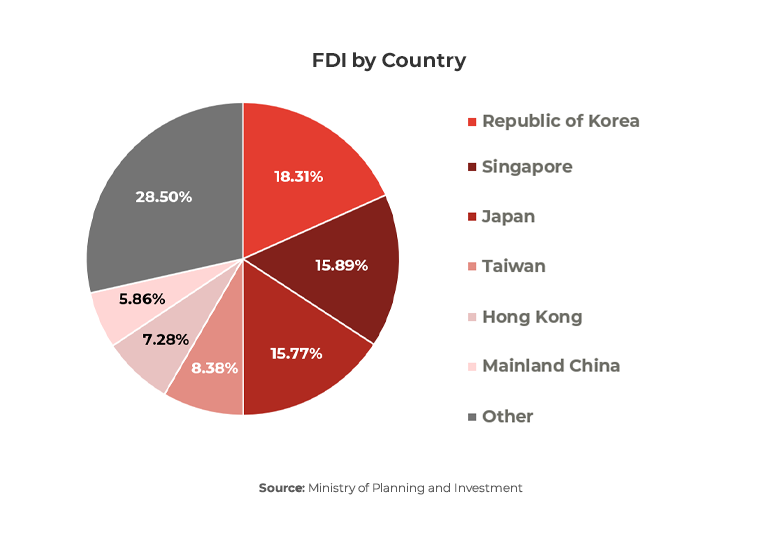
Vietnam, with its rapidly growing economy, offers abundant investment opportunities for foreign investors. However, understanding Vietnam’s investment regulations and legal framework is essential for making successful investments. In this post, we’ll explore how foreign investors can navigate Vietnam’s investment regulations, focusing on key factors such as foreign ownership laws, taxation, and business licensing requirements.
1. Vietnam’s Foreign Ownership Laws: What You Need to Know
Vietnam is becoming one of the most attractive destinations for foreign direct investment (FDI) in Southeast Asia. However, there are specific regulations regarding foreign ownership that investors must be aware of.
-
Foreign Ownership Limits: In most sectors, foreign investors are allowed to own up to 100% of the company. However, there are restrictions in certain industries, such as telecommunications, media, and national security, where foreign ownership is limited to 49% or lower. For instance, in listed companies, foreign investors can only own up to 49% of shares, and in non-listed companies, the limit is typically 30%. For more information on foreign ownership laws, refer to the Vietnam Ministry of Planning and Investment here.
-
Real Estate Ownership: Foreign investors are allowed to purchase real estate in Vietnam, but with restrictions. For example, foreign ownership in a building can’t exceed 10% of the total number of apartments, or 10% of the total land area in a project. This regulation aims to maintain local ownership while promoting foreign investment in the real estate market. You can check more details on property regulations from the Vietnam Real Estate Association here.
2. Key Business Licensing and Registration Requirements
To establish a business in Vietnam, foreign investors must comply with a series of licensing and registration procedures. While the process can take several weeks, it is relatively straightforward when following the right steps.
Key steps include:
-
Investment Registration Certificate (IRC): Foreign investors must obtain an IRC from the Vietnamese government, which provides the official approval for foreign investment projects. For more detailed steps on IRC, visit the Vietnam Government Portal here.
-
Enterprise Registration Certificate (ERC): Once the IRC is granted, the company must then apply for an ERC. The ERC is essential for the business to legally operate in Vietnam.
-
Other Necessary Licenses and Permits: Depending on the sector, businesses may need additional licenses or permits, such as environmental permits for manufacturing operations or sector-specific permits for the finance and telecom industries.
In general, the process of registering a company in Vietnam can be completed within 3 to 4 weeks if all documentation is properly prepared.
3. Corporate Income Tax (CIT) and Taxation Policies in Vietnam
Vietnam’s taxation policies are another crucial area for foreign investors to understand. The country has a competitive corporate income tax (CIT) rate, which is attractive for businesses looking to operate in Vietnam.
-
Corporate Income Tax Rate: The standard CIT rate in Vietnam is 20%. However, businesses in certain sectors, such as high-tech or manufacturing, may benefit from tax incentives that lower their CIT rate to as low as 10% for 15 to 30 years. You can learn more about tax incentives for foreign investors in Vietnam from the Vietnam Tax Authority here.
-
Value-Added Tax (VAT): Vietnam applies a 10% VAT on most goods and services. There are exemptions or reduced rates for certain products, including educational services and medical equipment.
-
Tax Incentives: Vietnam offers tax incentives for foreign-invested enterprises (FIEs), especially those in sectors such as renewable energy, high-tech manufacturing, and agriculture. These incentives include tax holidays, exemptions, and reductions for qualifying businesses.
Additionally, Vietnam’s membership in Free Trade Agreements (FTAs), including the EU-Vietnam FTA and CPTPP, provides foreign investors with favorable tax conditions. Learn more about Vietnam’s FTAs from the Vietnam Ministry of Industry and Trade here.
4. Navigating Vietnam’s Labor Laws and Employment Regulations
When operating a business in Vietnam, foreign investors must comply with the country’s labor laws. Vietnam’s labor market is one of the youngest in Southeast Asia, with a median age of just 30 years, offering a skilled workforce across various industries.
Key labor law considerations include:
-
Employment Contracts: Vietnam requires employers to enter into written labor contracts with employees. These contracts must define the terms of employment, including wages, working hours, and benefits.
-
Social Insurance: Both employers and employees contribute to Vietnam’s social insurance system, which includes pension, health insurance, and unemployment insurance.
-
Work Permits for Foreigners: Foreign nationals working in Vietnam must obtain a work permit from the Ministry of Labor, Invalids, and Social Affairs. Work permits are typically valid for 2 years and can be renewed.
For more information on Vietnam’s labor laws and work permits, visit the Vietnam Ministry of Labor here.
5. Protecting Intellectual Property (IP) in Vietnam
As a fast-growing economy, Vietnam is making strides in improving its intellectual property (IP) protections. Foreign investors, particularly those in the technology and creative industries, should be aware of the steps to protect their intellectual property in Vietnam.
Key IP protections include:
-
Patents: Vietnam is a member of the World Intellectual Property Organization (WIPO) and follows international patent laws. Patents in Vietnam are granted for a period of 20 years, with the possibility of extension.
-
Trademarks: Investors can register trademarks with the National Office of Intellectual Property (NOIP), which grants protection for a period of 10 years, renewable indefinitely.
-
Copyrights: Vietnam follows the Berne Convention, providing protection for original works of authorship, including software, music, and literary works.
You can find more details on IP protection in Vietnam through the National Office of Intellectual Property here.
6. Recent Updates to Vietnam’s Investment Laws
Vietnam has recently amended its Law on Investment and Law on Enterprises to make the investment process even easier for foreign investors. Some of the key updates include:
-
Faster approval processes: The government has streamlined procedures for obtaining investment registration certificates and business licenses, reducing the time needed for approval.
-
More favorable terms for high-tech investments: The new laws provide more attractive incentives for businesses operating in technology, research and development, and renewable energy sectors.
-
Investment transparency: Vietnam has committed to improving the transparency of its regulatory framework, including the establishment of more online platforms for investors to track the progress of their applications.
These updates reflect Vietnam’s commitment to attracting foreign investment and improving the ease of doing business. For more information on the changes to the Law on Investment, refer to the Vietnam Government Portal here.
Conclusion
Navigating Vietnam’s investment regulations requires careful understanding of its legal and regulatory framework. From foreign ownership limits and business licensing to taxation and labor laws, being informed about these regulations is key to making successful investments in the country. Vietnam’s government has made significant efforts to create a business-friendly environment, offering attractive incentives and support for foreign investors.
At DealFlow.sg, we specialize in helping international investors navigate Vietnam’s regulatory environment. Our expertise in local laws and our extensive network allow us to guide investors through the complexities of establishing and growing a business in Vietnam, ensuring compliance and maximizing opportunities for success.
