
As one of Southeast Asia’s fastest-growing economies, Vietnam offers significant investment opportunities. However, entering the Vietnamese market requires a clear understanding of the country’s regulatory environment. For foreign investors, navigating these regulations can be challenging, but with the right knowledge and resources, the process can be streamlined. This post explores the key regulatory factors that foreign investors should be aware of when considering investments in Vietnam.
1. Foreign Direct Investment (FDI) Regulations
Foreign direct investment (FDI) is a key driver of Vietnam’s economic growth, and the government has put in place policies to encourage and facilitate foreign capital inflows. FDI laws in Vietnam are governed by the Law on Investment (2014, amended in 2020), which outlines the rules for foreign investors, including sectors open to foreign investment, investment procedures, and investment incentives.
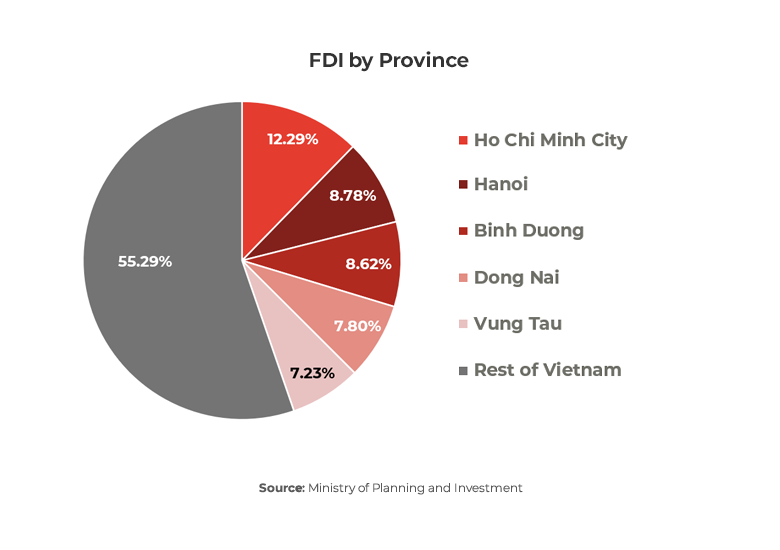
In 2021, Vietnam received US$31 billion in FDI, up 9% from the previous year. Key sectors for FDI include manufacturing, technology, renewable energy, and real estate. Foreign investors can establish businesses in Vietnam through a variety of mechanisms, including:
-
100% foreign-owned enterprises (FOEs): In certain industries, foreign investors can fully own and operate businesses.
-
Joint ventures (JVs): Foreign investors can enter into partnerships with local Vietnamese businesses.
-
Wholly foreign-owned subsidiaries (WFOEs): A fully owned entity in specific sectors like services, finance, and technology.
The Vietnamese government has continuously made efforts to liberalize foreign investment policies, making it easier for international businesses to enter the market. In particular, in recent years, the government has focused on simplifying registration and approval processes for foreign investors.
2. Investment Incentives and Free Trade Agreements (FTAs)
Vietnam offers various investment incentives to attract foreign investors, particularly in high-priority sectors like renewable energy, technology, and infrastructure. Some of the key incentives include:
-
Tax holidays and reductions: Certain businesses may receive tax exemptions or reductions for a specified period. For instance, businesses in industrial zones and export processing zones can benefit from these incentives.
-
Reduced corporate income tax rates: Businesses in certain sectors may benefit from tax rates as low as 10% for a period of 15-30 years.
-
Investment support in high-tech industries: The Vietnamese government provides preferential treatment for investors in industries such as high-tech manufacturing, IT, and renewable energy.
Additionally, Vietnam is a member of several Free Trade Agreements (FTAs), including the Comprehensive and Progressive Agreement for Trans-Pacific Partnership (CPTPP) and the EU-Vietnam Free Trade Agreement (EVFTA), which provide favorable trade conditions and reduced tariffs for foreign investors operating in Vietnam.
3. Business Licensing and Registration
Setting up a business in Vietnam involves several steps, including obtaining a business license, registering the company with the relevant authorities, and obtaining necessary permits. The process can be completed in 3-4 weeks, provided all the documentation is in order. Key steps in the registration process include:
-
Obtaining an Investment Registration Certificate (IRC): This certificate is required for most types of foreign investment and outlines the project and its objectives.
-
Obtaining an Enterprise Registration Certificate (ERC): This certificate is necessary to legally operate a business in Vietnam.
-
Opening a corporate bank account: Foreign investors must set up a bank account for the company’s transactions.
It is also important to note that certain sectors in Vietnam have restrictions on foreign ownership. For example, foreign investors are generally limited to owning 49% of shares in Vietnamese-listed companies, and 30% in non-listed companies, except for certain industries like telecommunications and national security.
4. Land Use and Real Estate Regulations
Real estate investment in Vietnam is attractive, especially given the rapid urbanization and the growing demand for commercial and residential properties. However, foreign investors must navigate land use rights, which are often subject to Vietnamese law.
In Vietnam, land ownership is regulated by the government, and foreigners cannot directly own land. Instead, foreign investors can lease land for a period of up to 50 years, with the possibility of extension. In the case of joint ventures, foreign investors can lease land alongside their Vietnamese partners.
Additionally, the Law on Housing (2014) allows foreigners to own up to 10% of the total apartments in a building or 10% of the land area of a landed project. These restrictions aim to maintain control over the real estate market while encouraging foreign investment.
5. Employment and Labor Laws
Vietnam has a young and rapidly growing labor force, making it an attractive market for labor-intensive industries. However, foreign investors should be aware of Vietnam’s labor laws when hiring employees. Key aspects include:
-
Labor contracts: Employers are required to provide written labor contracts for all employees. These contracts must outline the terms of employment, including wages, working hours, and benefits.
-
Social insurance: Employers must contribute to social insurance, health insurance, and unemployment insurance for their employees.
-
Work permits: Foreign employees working in Vietnam must obtain work permits, which are issued by the Ministry of Labor, Invalids, and Social Affairs.
6. Vietnam’s Commitment to Business Transparency and Anti-Corruption
Vietnam has made significant strides in improving its business environment and ensuring transparency in business dealings. The government has implemented measures to combat corruption, strengthen corporate governance, and improve the legal framework for business operations. Vietnam’s membership in international organizations like the World Trade Organization (WTO) also reflects its commitment to fostering a fair and transparent business environment.
Conclusion
Vietnam’s regulatory environment for foreign investors is continually evolving, with the government actively working to simplify the process and provide incentives for international businesses. While navigating the legal landscape can be challenging, foreign investors can benefit from Vietnam’s growing economy, strategic location, and strong government support for investment.
At DealFlow.sg, we help investors understand Vietnam’s regulatory environment and navigate the complexities of investing in the country. Our expertise in Vietnamese business regulations and our deep understanding of the local market make us the ideal partner for foreign investors looking to enter Vietnam’s rapidly expanding economy.
